A logistics operator can be involved in different stages of the supply chain: from receiving and storing goods to order preparation, distribution or returns management.
The functions it performs will depend on each company's needs and the scope of the contracted service. Some organisations outsource only certain processes, while others entrust a large part of their operations to a specialised partner.
These are the main functions a logistics operator can perform and how it is involved in each of them.
One of the first functions of a logistics operator is to receive products from manufacturers, suppliers or distributors and store them in suitable facilities until they are needed. The storage system must also be adapted to the characteristics of the goods. Factors such as size, weight, fragility, turnover or special storage conditions determine how and where each product should be stored.
Receiving goods may include checking quantities, inspecting the condition of products, recording incoming goods and assigning a location within the warehouse. Proper organisation makes it easier to locate each item, optimises the available space and subsequently speeds up order preparation.
Knowing how many units are available and where each product is located is essential for maintaining efficient operations. A logistics operator can record stock movements, update stock levels and provide information on available inventory. This control makes it possible to identify slow-moving products, anticipate replenishment needs and reduce both stockouts and unnecessary stock accumulation.
In ecommerce operations, inventory can also be synchronised with sales channels to keep product availability up to date and reduce the risk of accepting orders for items that are no longer available.
When an order is received, one of the most important processes in logistics operations begins: locating the products, picking the corresponding items and preparing them correctly for dispatch. Its impact within the warehouse is considerable: an academic review published in the European Journal of Operational Research estimates that picking can account for up to 55% of a warehouse's operating costs.
Picking involves selecting and collecting the products that make up each order from the warehouse. Proper organisation of this process helps reduce travel distances, speed up order preparation and prevent errors involving products, quantities, models or item references.
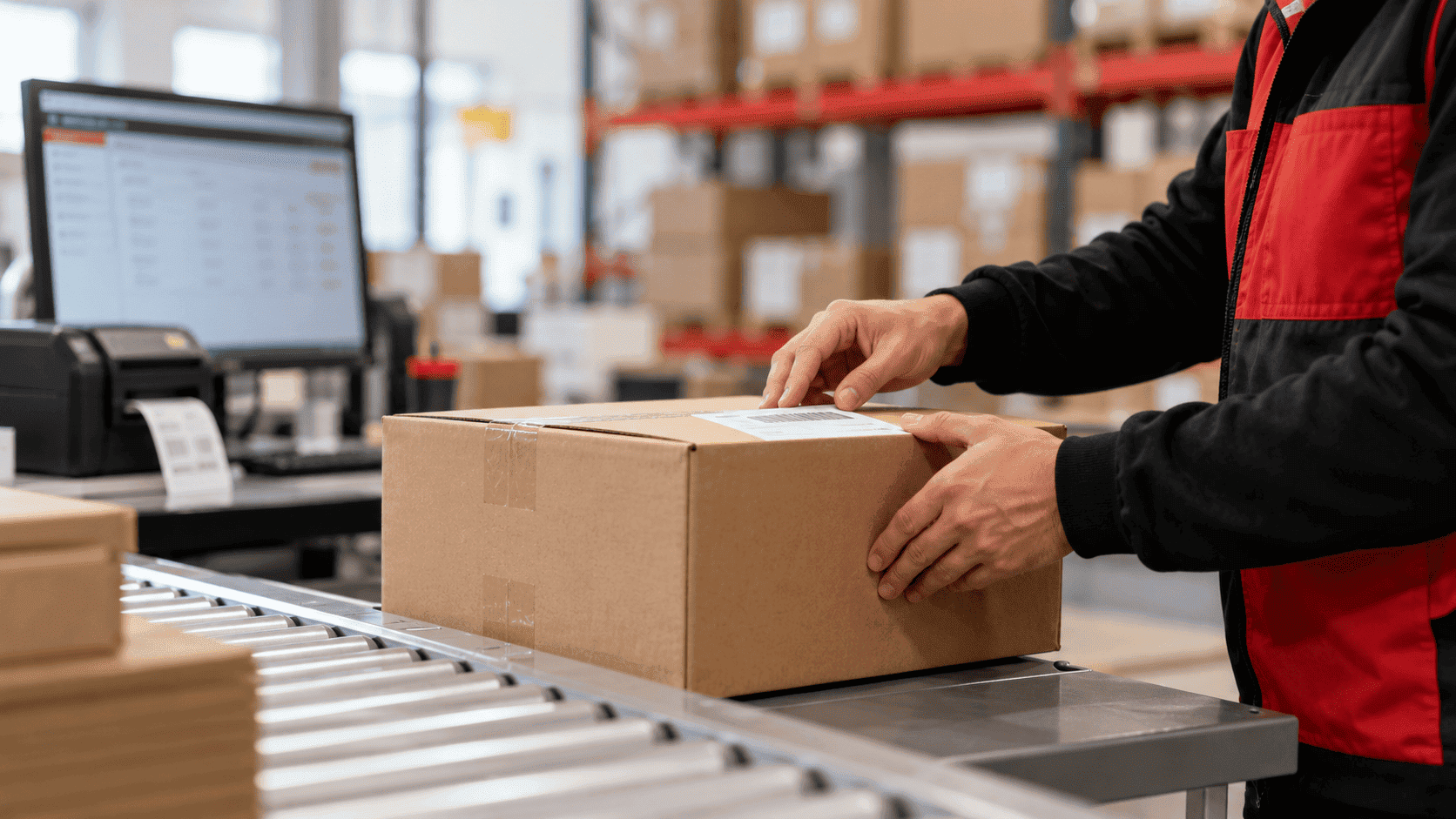
Packing is the subsequent stage, in which items are checked, protected, packed and labelled for shipping. Depending on the company's needs, documentation, promotional materials or other personalised elements may also be included.
When an operator manages processes such as warehousing, inventory, order preparation and dispatch in a coordinated way, this is known as a fulfillment service, which is particularly relevant for ecommerce.
Packaging plays an essential role during transportation: protecting the product until it reaches its destination. However, the choice of packaging can also influence distribution costs and the recipient's experience. For fragile, high-value or unusually sized products, it may be necessary to develop specific solutions, taking into account factors such as weight, fragility, route or mode of transport.
A logistics operator can select materials and formats suited to the characteristics of each shipment, avoiding both insufficient protection and oversized packaging that unnecessarily increases the weight or volume of the shipment.
Another of the main functions of a logistics operator is to coordinate the movement of goods from the warehouse to the customer, a retail outlet, another distribution centre or any other destination. This management may include selecting the carrier, choosing the service, generating documentation, coordinating collections and tracking deliveries.
Not all orders have the same requirements. The destination, delivery timeframe, dimensions of the goods or handling conditions may make one solution more suitable than another. International shipments may also involve aspects such as customs documentation, taxes, duties or restrictions in the destination country.
Working with a multi-carrier network of different transport providers makes it possible to select the most suitable option for each shipment, rather than applying a single solution to all shipments.
Traceability makes it possible to know what happens to products throughout logistics operations. To achieve this, the different movements of goods must be recorded and accessible to those responsible for managing them.
A logistics operator can provide information on available inventory, prepared orders, shipments in transit, completed deliveries or detected incidents. This visibility makes it easier to monitor operations and respond more quickly to potential deviations. It also helps provide customers with up-to-date information on the status of their orders.
Technology makes it possible to connect different logistics processes and reduce manual tasks that take time and can lead to errors. For example, an integration between an online store and logistics systems can allow orders to be transmitted automatically, the labels required for dispatch to be generated and tracking information to be subsequently sent back to the sales channel.
These integrations make it easier to manage a higher volume of orders and are particularly useful when a company sells through different channels. Ecommerce shipping automation solutions make it possible to centralise and simplify some of these processes.
Logistics operations do not always end with delivery. A product may need to be returned due to a return request, an exchange, an incident or rejection by the recipient. Reverse logistics covers the processes required to manage this return journey. Depending on the product and the operation, it may include collection, transportation, inspection, reintegration into inventory, reconditioning or transfer to another destination.
In ecommerce, managing this process correctly becomes even more important. According to the Retail Returns Landscape 2025 study by the National Retail Federation, it was estimated that returns would account for 19.3% of online sales in the United States in 2025, reflecting the significant role that reverse logistics can play in this channel.
Having a defined returns procedure makes it possible to keep inventory up to date, streamline returns management and reduce the impact of these operations on the rest of the business.
The role of a logistics operator does not have to be limited to carrying out the operations that a company decides to outsource. It can also analyse how these processes are performed and identify opportunities to improve their efficiency. This analysis may cover warehouse organisation, picking routes, inventory management, packaging materials, carrier selection, preparation times or the capacity required to respond to peaks in demand.
The aim is to adapt operations to the company's actual needs, make better use of resources and build a model capable of evolving as the volume or complexity of the business increases.
No. The scope of services can vary considerably from one operator to another. Some specialise in specific stages of the logistics chain, while others can coordinate different processes within a single solution.
Furthermore, a company does not necessarily have to outsource all its logistics operations. It can continue to manage internally those activities it handles efficiently and delegate only the processes that require more space, technology, resources or specialised expertise.
For this reason, before working with an operator, it is important to analyse which processes the company needs to outsource and what capabilities the provider must have to support the evolution of its operations.
The functions a logistics operator should perform depend on the type of product, volume of activity, sales channels, destinations and objectives of each company. That is why an effective logistics solution should not be based on a standard model, but on the specific needs of each business.
At Mail Boxes Etc., we design logistics solutions for businesses and ecommerce by combining the services required for each operation: logistics consulting, warehousing, order preparation, packaging, distribution, technology and returns management.
In addition, the ongoing support of an MBE expert makes it possible to analyse how operations evolve and adapt the solution as business needs change.
.png)